

1. Model introduction
Cosmos3 is NVIDIA’s Mixture-of-Transformers (MoT) omni family: an UND (understanding) tower and a GEN (generation) tower over a joint text+vision packed sequence, with the Wan2.2 VAE (4× temporal compression). This guide covers Cosmos3-Nano, the variant validated by the canonical recipe and training curve. Key highlights for RL training:- No separate text encoder. Conditioning is token-level:
CondKwargscarriestext_ids/text_mask/fpsverbatim, which eliminates the text-replay-consistency failure class other families guard against. - UND tower frozen inside the training graph. The UND tower participates in the packed forward, so it is frozen by
parameter-name fragments rather than dropped; LoRA targets are GEN attention only (
add_q_proj,add_k_proj,add_v_proj,to_add_out). - Packed single-sample forward. The transformer consumes one packed text+vision sequence per forward — one request
cannot batch multiple outputs, so recipes run
--rollout-microgroup-size 1and CFG batching is disabled by construction. - Shifted flow-sigma grid. sgl-d builds Cosmos3’s sigma grid as a linear grid warped by flow shift 3.0 for T2I (through its FlowUniPC serving scheduler, which overrides the checkpoint’s scheduler class). Rollout requests do not use UniPC: they take that grid verbatim on a FlowMatchEuler scheduler and step it with Euler (ODE steps) or the SDE kernel (SDE steps). Step sizes are non-uniform, so SDE candidate steps must be derived from the grid.
2. Validated variant
Only Nano has a validated recipe and training curve.3. Family config
Frommiles/backends/fsdp_utils/configs/cosmos3.py:
4. Launch
Canonical recipe:scripts/run_diffusion_grpo_cosmos3_pickscore_t2i_4gpu.py — train, rollout,
and PickScore colocated on 4 GPUs; T2I (832×480, 1 frame).
Status: 🛡️ FG — Fully gated
SGLANG_DISABLE_COSMOS3_GUARDRAILS=1 in the job environment: RL scores raw
samples, so the serving-side guardrail models are skipped.
5. Recipe notes
epoch_global_random_choice draws two steps from
--diffusion-sde-candidate-steps 8,9,10,11, shared by each block of --rollout-batch-size consecutive prompt groups (one rollout, unless a dynamic-sampling filter drops groups).
On the 16-step rollout grid (linear, T2I flow shift 3.0, taken verbatim from the serving scheduler), steps 0–7 run
σ ≈ 1.00 → 0.79 with |dt| ≈ 0.02–0.04, and the candidates 8–11 sit at σ ≈ 0.75 → 0.58 with |dt| ≈ 0.05–0.08.
Step numbers are not transferable across grids: re-derive candidates from σ and |dt| when changing the
model, the step count, or the shift.
6. Reference results
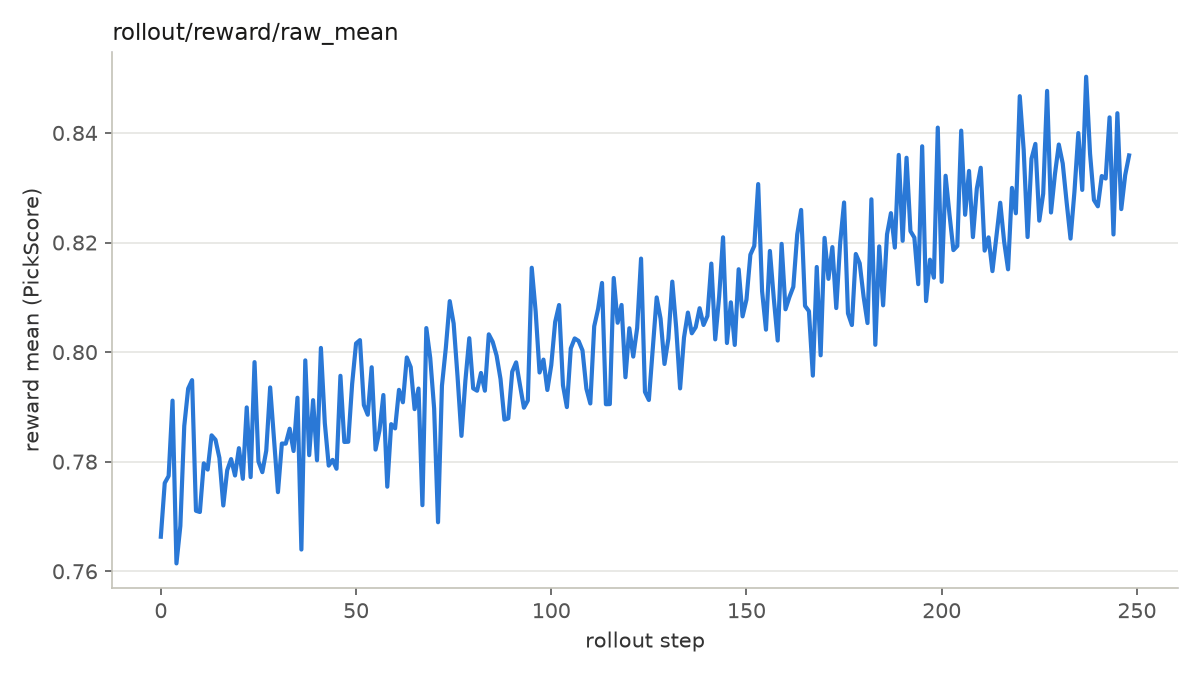
The 4-GPU colocated Cosmos3-Nano recipe raises PickScore (rollout/reward/raw_mean) from ~0.77 to ~0.85 over 250 rollouts:
7. Pairs well with
- LoRA Training and Weight Sync — GEN-tower LoRA sync.
- Rewards — PickScore worker pool configuration.